















FSC-Certified Paper Bags: What Buyers Should Verify
A practical buying guide to FSC paper bag claims: identify the seller, check certificate status and scope, connect the product and label, and reconcile the final sales documents. Certification must be verified for the specific supply arrangement.
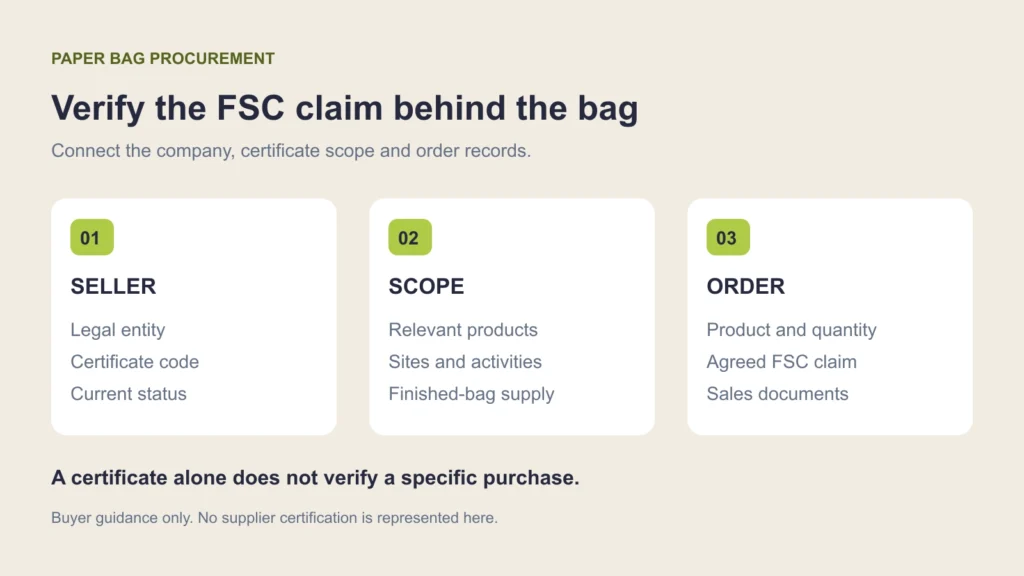
Before accepting paper bags as FSC certified, connect three pieces of evidence: the selling entity, the certificate covering the relevant products and activities, and the documents for your actual order. A certificate PDF or a logo on a sample cannot complete that check by itself.
Agree the FSC requirement before ordering, then verify it again against the bags and records you receive. FSC's purchasing guidance recommends checking supplier validity, product scope and the claim on the sales documentation. The steps below are a procurement guide; they do not establish PAQIVA's FSC certification or eligibility to supply an FSC-certified order.
1. Define what you need the label and claim to mean
FSC labels describe the relevant forest-based material. The three familiar categories give a useful starting point:
- FSC 100%: The forest-based material comes from FSC-certified forests.
- FSC Mix: Eligible inputs may combine FSC-certified, recycled and controlled material. Controlled material is not itself FSC-certified forest material.
- FSC Recycled: The forest-based material is verified as 100% reclaimed; it need not all be post-consumer material.
Use FSC's label definitions to interpret the category. Check plastic content, recyclability and any food-contact requirement separately.
The label on a bag and the claim on a business document serve different purposes. For example, FSC Mix 70% and FSC Mix Credit can both correspond to an FSC Mix label. Do not read the label as a fixed recycled-content percentage for each individual bag. FSC explains these distinctions in its claims and labels guide.
Decide whether you require labelled finished bags for your own use, a particular claim on purchasing records, or material that your organisation will process or resell with an FSC claim. State that requirement in the brief; these uses do not all have the same documentation and certification needs.
2. Identify the seller and search the official record
Ask for the legal name and address of the business selling the bags, its FSC certificate code and the relevant trademark licence code. Compare the legal entity with the quotation and proposed invoice issuer, rather than relying on a website trading name.
Open FSC Search yourself. Select the certificate records for Forest Management and Chain of Custody, and search by certificate code, licence code or organisation name. Use the certificate detail record to identify the holder; a similarly named company is not enough. The database also offers advanced filters and downloadable, time-stamped records.
There are two identifiers to keep separate. The certificate code identifies the certification used for the supplier's transaction claims. The trademark licence code identifies the licence used for FSC trademark use. Both can help you find a record, but a licence code printed next to a logo does not replace the required certificate information on sales documents.
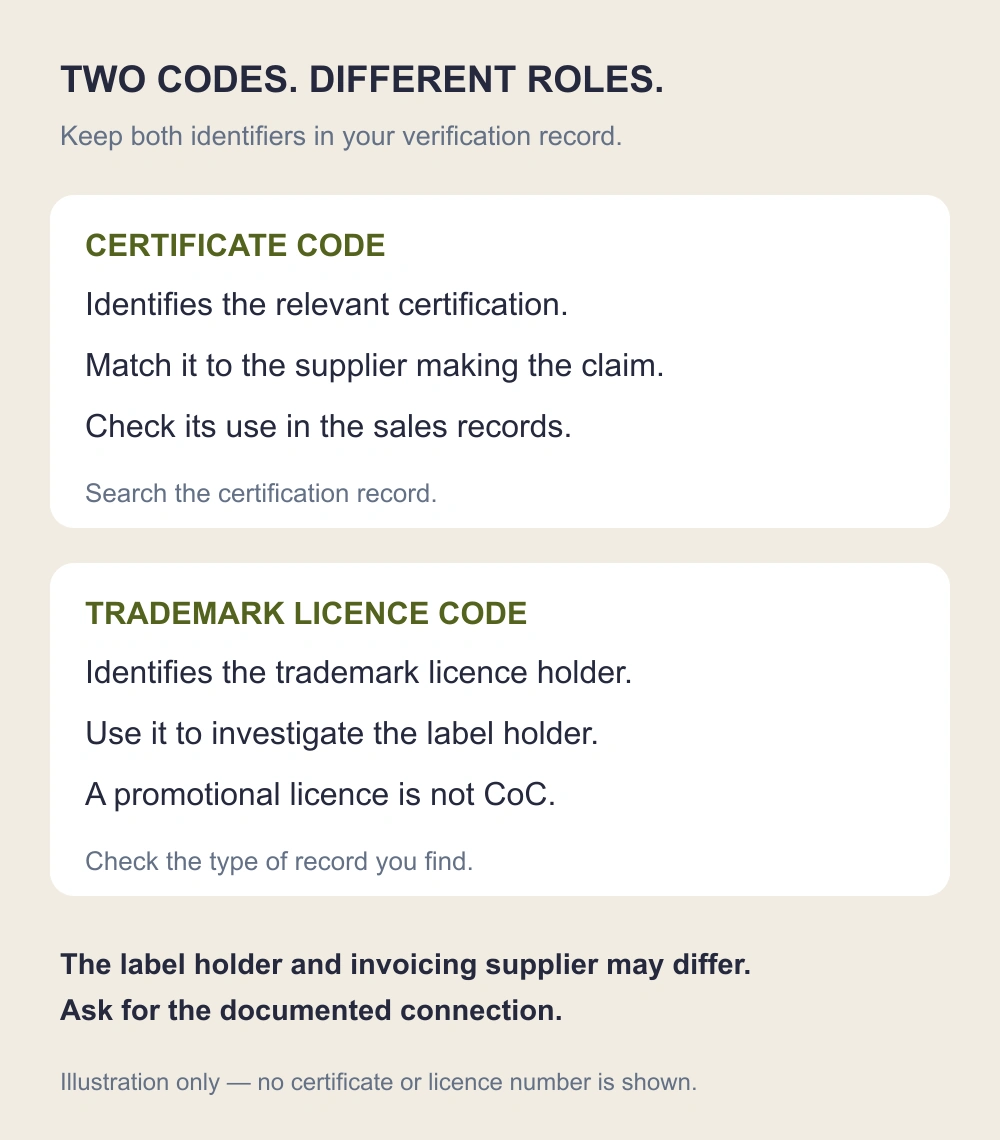
A promotional licence is different again: it permits specified promotional use, rather than functioning as a Chain of Custody certificate. An uncertified retailer selling unchanged, already-labelled finished goods is not automatically selling an invalid product. For a custom manufacturing order or an onward FSC claim, establish the appropriate certified route and documentary evidence. FSC's buying guidance distinguishes these situations.
3. Check status, sites and finished-bag scope
For finished bags, establish the relevant Chain of Custody coverage; a forest-management record alone is insufficient. Read the record against this order, using four checks:
- Holder: Does the named organisation match the seller, or is there documented evidence connecting the relevant participating site or group member?
- Status and dates: Is the certificate currently valid for the proposed supply? Note its dates and when you checked it. Recheck before accepting the order's FSC claim.
- Sites and activities: Does the relevant location and its role fall within the certified arrangement? A related company or another factory is not covered just because it shares a brand name.
- Products: Does the scope support the finished paper bags and the activities involved? A certificate for a paper mill or a different product category does not by itself establish finished-bag eligibility.
FSC's certificate-search guidance explains checking validity, scope and sites. Product classification helps you locate the right area, but a broad paper-products entry is not proof that your exact bag is supplied with an FSC claim. Ask the supplier to connect its product information and specification to the relevant scope.
If the record is suspended, terminated, expired or unclear, pause acceptance of a new FSC claim and ask the listed certification body to clarify. If no record can be found, request the exact code and certification body from the supplier, then verify through official contact details. For an earlier delivery, investigate the status and documents at the relevant transaction date; today's status alone does not settle the history.
Where a trader, agent or outsourced converter is involved, request a simple explanation of who owns the goods, produces them, issues the claim and applies the label. Outsourcing has defined rules; it does not mean every service provider must hold an independent certificate, or that a trader can simply borrow a mill's code. Ask the listed certification body to resolve an unclear arrangement. FSC's CoC standard, outsourcing section sets the framework.
4. Connect the product specification and label artwork
Record the bag size, paper, handle construction, printing, finish, product reference and quantity for each version. Ask which finished products will carry the agreed FSC claim. Keep that answer with the quotation or order confirmation so a later material or supplier change can be checked against it.
If an FSC label is required on the bag, obtain the artwork proof from the responsible certified supplier and establish who is responsible for its approval. Do not copy a label from an unrelated bag into the design file. The code on the label may belong to an upstream certificate holder or an approved labelling arrangement, so it need not be identical to the invoicing supplier's code. Ask for the connection to be explained.
FSC's trademark rules also distinguish packaging from its contents: a label that refers to the bag does not also certify the clothing or gifts inside. As of September 2026, revised trademark rules are in a transition period, with the latest transition date of 31 December 2028. Different label layouts alone are therefore not a reliable test of authenticity. Use the applicable approval route and FSC's current trademark guidance.
5. Read the sales documents against the delivered bags
For a sale made with an FSC transaction claim, use FSC's delivery checklist to locate these fields on the supplier's records:
- The issuing organisation and contact details, plus the customer where required.
- The document date.
- The product description and quantity, matched to the bags received.
- The applicable supplier certificate code.
- The FSC claim clearly attributed to the relevant product lines.
Cross-reference the records to your purchase order. Under FSC-STD-40-004, section 5, delivery documents can form part of the evidence, and supplementary claim documents require the supplier's certification body's permission and the standard's conditions. A generic logo in an invoice header does not show which items carry an FSC claim.
If the invoice contains both certified and non-certified items, make sure the distinction is unambiguous. Match the product reference, size or design and quantity against the delivery. A quotation promising certification is useful for setting expectations; it is not a substitute for the completed transaction records.
Some permitted sales of finished, labelled products at the end of the chain can omit the percentage or Credit detail. Do not invent that detail from an FSC Mix label. If your intended use requires a full claim for onward processing or sale, resolve this requirement before purchase.
6. Resolve gaps and keep an order-specific evidence file
An unexplained difference calls for clarification, not an immediate accusation of fraud. Ask the supplier to correct or explain missing claims, conflicting entities, changed product references or different label-holder codes. Where supplementary evidence is used, it must clearly connect the relevant products and transaction. Never edit the supplier's certificate number or claim yourself.
If the explanation depends on outsourcing or another business's code, verify the arrangement with the named certification body. Current FSC CoC interpretations distinguish permission to display a contracting organisation's code from authority to issue an FSC transaction claim. Those are not interchangeable.
Keep one file containing the dated database record, relevant scope/site evidence, agreed product specification and claim, approved label proof if applicable, and the final sales/delivery records. Add any explanation or correction and the name of the person who reviewed it. Record unresolved items as pending; a valid certificate should not automatically close an incomplete order check.
When sending PAQIVA a paper bag project brief, include your dimensions, quantities and any mandatory FSC requirement. The purchasing decision should depend on verified certification and evidence for the specific order, separately from the bag's design, appearance or price.