
















Are Ribbon-Handle Paper Bags Recyclable? A Buyer’s Guide
A paper body does not settle the recyclability of a complete ribbon-handle bag. Review its components, the destination's collection rules and the claim on your artwork.

Ribbon-handle paper bags may have a recycling route, but the complete bag should not automatically be treated as paper. The paper body, surface finish, ribbons and fittings need to be considered together, then checked against the collection system where the customer will dispose of the bag.
For a buyer, the useful question is more specific than “Is it recyclable?” Ask which parts are accepted, what must be removed, and whether customers can actually use that route. Those answers should shape both the bag specification and the disposal message printed on it.
Check the whole bag, component by component
A white shopping bag with pink ribbon handles can look simple while containing several different materials. A photograph shows the design; it does not establish the ribbon fibre, coating chemistry or recycling acceptance.
Use the finished sample and a written material specification to identify the following parts.
| Component | What the buyer should confirm |
|---|---|
| Paper body and reinforcing cards | Paper or board grade, any lining, and whether the bottom insert uses the same material and finish. |
| Surface finish | Whether the bag has plastic film lamination, another coating, varnish or decorative layers; record the actual specification. |
| Ribbon or cord | Fibre or polymer composition, how it is attached, and whether the complete handle can be removed. |
| Small fittings | Metal eyelets or rivets, plastic end pieces and other attachments, including their destination after separation. |
Keep recycled content, recyclability and compostability as separate questions. Likewise, FSC sourcing claims do not determine whether the finished bag is accepted by the destination's collection system. Our FSC paper bag verification guide covers the separate sourcing and certificate checks.
How the paper body and finish affect the answer
An unlaminated paper body can simplify the material specification, but “paper” alone is not a recycling approval. Include the bottom card, folded top, adhesive and any inner liner in the description sent to the recycling service or assessor. Empty the bag and follow that service's requirements for cleanliness and preparation.
Gloss does not reliably identify plastic film, and a matte surface does not prove that a bag is unlaminated. Ask the supplier to name the finish instead of judging it from a photograph. A film laminate is also different from a varnish or another applied coating; “water-based” by itself does not settle the recyclability of the finished construction.
There is no useful universal rule that every laminated paper bag can, or cannot, be recycled. The relevant combination of paper and added materials must suit the recycling process. 4evergreen's Circularity by Design guidance distinguishes conventional, deinking and specialised routes. Technical suitability for one route does not establish that customers have access to it.
If a supplier provides a recyclability assessment, check that it covers the ordered construction, including its finish and attachments, and identify the intended recycling route. A result for the base paper does not automatically cover the assembled bag.
Ribbon handles need their own disposal decision
Satin, grosgrain and herringbone describe ribbon appearance or structure; they are not enough to establish fibre composition. Ask what the ribbon is made from and whether printing or other treatments are added.
Even a confirmed cotton ribbon should not be assumed to belong in paper recycling. For example, Calgary's paper-bag instructions tell residents to remove ribbons and rope handles; they do not provide a cotton exception. Reuse a serviceable ribbon where practical, then follow the destination's instructions for that separate component.

Attachment design affects how practical separation will be. With a threaded handle, inspect the inside fastening as well as the visible ribbon. An end piece or knot may have to be released before the whole handle comes out. With a glued-in handle, assess how much ribbon remains within the folded top after removal; cutting off the hanging loop may leave material behind.
Compare threaded ribbon handle bags with your proposed construction, then try the removal process on the actual sample. Do not describe a handle as “easily detachable” until that experience has been checked.
Metal eyelets and rivets are small but relevant

Metal rings around a carrying hole and rivets securing a handle add components to the bag. The same applies to plastic ribbon end pieces. Record these parts even if they represent a small share of the total weight.
A loose fitting is not automatically accepted in household metal or plastics collection just because of its material. Calgary, for instance, specifically directs removed bag rivets to its garbage cart. Other destinations may give different instructions. Check the route for the removed item rather than adding a general “recycle the metal” instruction.
Where separation would be awkward or leave sharp edges, consider reducing the hardware in the original design. The sample should still meet the intended carrying requirement; easier sorting is not a reason to weaken the connection.
Would a die-cut handle bag make sorting easier?
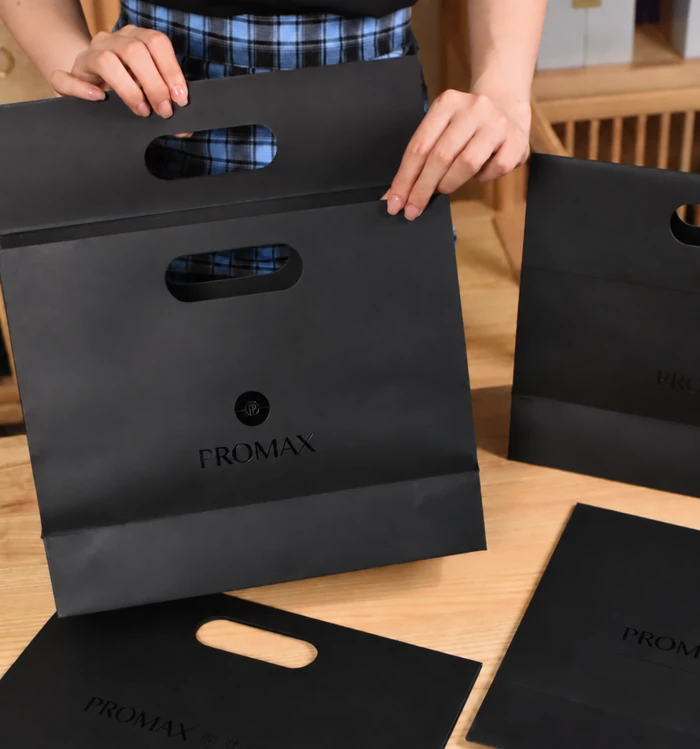
The black bags shown here have carrying openings cut into the paper body. They are die-cut handle bags, with no separate ribbon or rope handles to remove. That simplifies the component list and removes one potential sorting step.
This is a useful design option when a separate ribbon is not essential to the presentation. The opening, top reinforcement and bag proportions still need to work with the contents and feel comfortable in the hand.
However, an integrated handle does not establish that the entire bag is recyclable. The black surface could have treatments that are not identifiable from the photograph. Check the film, coating, lining and reinforcement specification before making a claim. A bag without separate handles is a simpler construction choice, not a recycling certification.
Confirm the destination before printing disposal instructions
Local instructions can differ, even when two bags look similar. The following examples were checked on 5 October 2026:
- Calgary, Canada: paper shopping and gift bags can enter the blue-cart or community-depot route. Paper handles may remain; ribbons, rope handles and metal rivets are removed and placed in the black garbage cart. See the city's paper shopping and gift bag guidance.
- Bromley, UK: after reuse is no longer suitable, paper parts without lamination or glitter can be separated for paper collection; the remaining gift-bag material goes to non-recyclable refuse. See Bromley's gift-bag instructions.
These are local examples, not rules for every part of Canada or the UK. For each sales destination, identify the applicable household collection service. For bags recovered at a shop or event, ask the contracted waste collector about that specific commercial route. Keep its answer with the specification, and recheck it when the materials, destination or printed instructions change.
Write a claim that matches the evidence
“100% recyclable” on the whole bag can communicate more than the evidence supports if only its paper body has an accepted route. Adding a small “check locally” line does not automatically fix that problem. The US FTC Green Guides on recyclable claims address both the portions covered by a claim and access to recycling facilities; vague qualifications can be inadequate where access is limited.
For artwork review, distinguish three kinds of wording:
- A verified construction description: “Paper body without plastic film lamination, with ribbon handles.” Use it only if the specification confirms it. This does not claim that the whole bag is plastic-free or recyclable.
- A destination-specific disposal instruction: identify the paper body, what the customer must remove, the collection route and where the separated components go. If recycling access is limited, describe that limitation clearly rather than hiding it behind a generic qualification.
- A whole-bag recyclability claim: obtain evidence for the finished combination and the relevant market's access to a suitable route before using it. Evidence for the paper alone is insufficient.
Ask the supplier for the evidence behind a statement instead of copying the wording from a quotation. The UK CMA's supply-chain guidance explains why businesses need to substantiate environmental claims they make or pass on. When recovery evidence is missing, a confirmed description of the materials is more useful than an unsupported environmental promise.
Plan the bag and its disposal message together
PAQIVA makes paper bags to project specifications, including the paper, finish, handle style and attachment. Discuss the destination and intended disposal route alongside the visual design. That makes it possible to compare a ribbon-handle construction with a design using fewer separate components before the artwork is finalised.
Send your product dimensions, expected filled weight, quantity, destination and preferred appearance when you discuss a custom paper bag with PAQIVA. Bring any collection requirements or assessment criteria your market needs. The next step is to agree a specification and review the sample, then write a disposal message supported by that construction and its actual destination.