













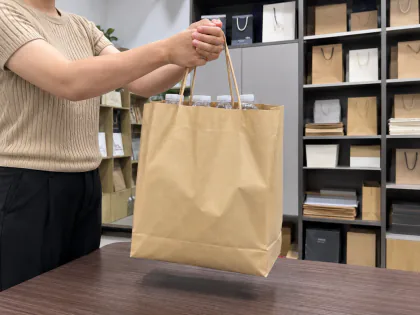
Clothing Packaging: Gift Bags, Gift Boxes, or Both?
Start with a paper bag for everyday clothing purchases, then add a gift box when the occasion and per-order margin justify it.
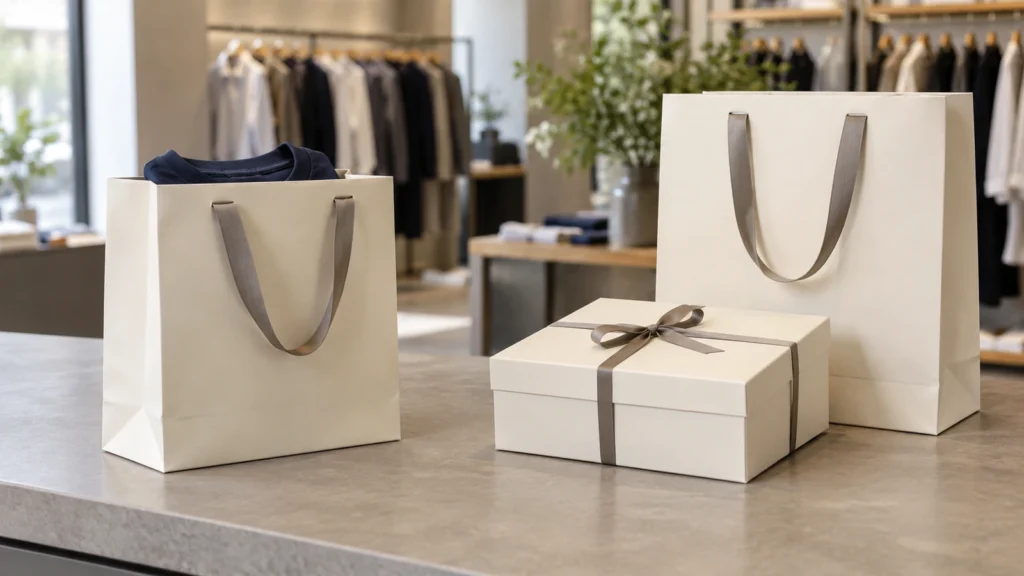
For everyday clothing purchases, start with a well-sized paper bag. Add a gift box when the order needs a gift presentation or an organized set—and the margin can support the extra packaging and packing time. If a gift box has suitable handles, it may replace the separate carrier. The useful question is how much the complete packaging adds to each order, and what the customer gains from it.
A higher selling price does not automatically leave more room for packaging. Discounts, garment cost and other order expenses can change that calculation. For a small clothing brand, a practical starting point is one everyday bag option and a gift-box upgrade used where it earns its cost.
Cover image: an illustrative clothing-store packaging scene.
Compare the complete packaging options
| Option | A useful starting point for | Main trade-off |
|---|---|---|
| Paper bag | Everyday folded clothing and straightforward store handover | Easy to carry; less structure around the garment. |
| Gift box | A presentation set that already has a carrying or shipping solution | Neat arrangement; a handleless box still needs a practical journey home. |
| Gift box plus bag | Gift purchases and orders where presentation and carrying both matter | Two packaging items, more storage and more packing work. |
| Gift box with handles | A boxed gift intended to be carried directly | May remove the outer bag, but the complete box can still be costly. |
“Gift box” covers different constructions. A folding apparel carton and a substantial rigid box should not be treated as the same purchase. Size, structure, decoration and order quantity all affect the quote; Paper Mart's explanation of gift-box costs makes that distinction. Compare the actual specifications rather than assuming every box costs more than every bag.
Set a packaging budget per order
Count the bag, box, tissue or other wrapping, labels, ribbon and packing labor. Use prices that include the packaging's delivery to your stockroom, or add that delivery cost separately—once. Also consider storage and damaged or obsolete stock when they are material to the decision.
Here is an illustrative store-pickup order, not a market quotation or a PAQIVA price. Revenue after discounts and excluding sales tax is $60. The garment costs $30, and other order costs are $6, leaving $24 before packaging. The merchandise and sales conditions are identical in both options.
In the table, bag and box prices include delivery to the stockroom; wrapping covers tissue, seals or decoration.
| Item | Bag | Box + bag |
|---|---|---|
| Bag | $0.70 | $0.70 |
| Box | $0.00 | $2.50 |
| Wrapping | $0.20 | $0.40 |
| Labor | $0.30 | $0.60 |
| Packaging total | $1.20 | $4.20 |
| Amount left | $22.80 | $19.80 |
Labor here assumes $18 per hour and one minute for the bag option versus two minutes for the box-and-bag option. These are planning assumptions, not measured packing speeds or local wage figures. The amounts left are not net profit: rent, overhead, tax and any unlisted costs still need to be covered.
The gift-box option uses $3 more per order, or $300 across 100 identical orders. Decide whether the gift experience justifies that expense, whether it belongs only on selected orders, or whether customers can choose a paid upgrade. An added charge is a pricing decision; the calculation does not prove what customers will pay.
Keep the order commitment in view, too. A lower unit quote may require more bags or boxes than you can use before the design changes. Request the minimum for each size and artwork, and compare the first payment, carton dimensions and expected usage alongside the per-order cost.
When a paper bag is enough for clothing
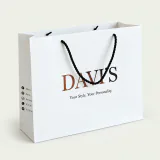
For a customer buying a T-shirt, folded knitwear or a simple clothing combination for personal use, a suitable paper carrier can complete the handover without a box. The bag should accommodate the folded purchase without forcing it through the opening or leaving excessive loose space.
Branding does not require a complicated packaging set. A clear logo, appropriate proportions and comfortable handles can give the bag a deliberate appearance. Tissue or another appropriate inner wrap can help keep the clothing together; select it for the garment and the expected conditions, rather than adding layers by habit.
Start with the combinations your store actually sells. A single shirt, a bulky sweater and two garments bought together may need different space, but that does not mean each product needs its own bag size. A small range based on common purchases can simplify stock and packing. PAQIVA's clothing paper-bag options are a useful starting point for this brief.
When a gift box and a bag earn their cost
A box is more useful when the customer is giving the purchase as a present, when several items need to stay arranged as a set, or when the garment benefits from more structure during handover. A bag then gives the customer a convenient way to carry that box.

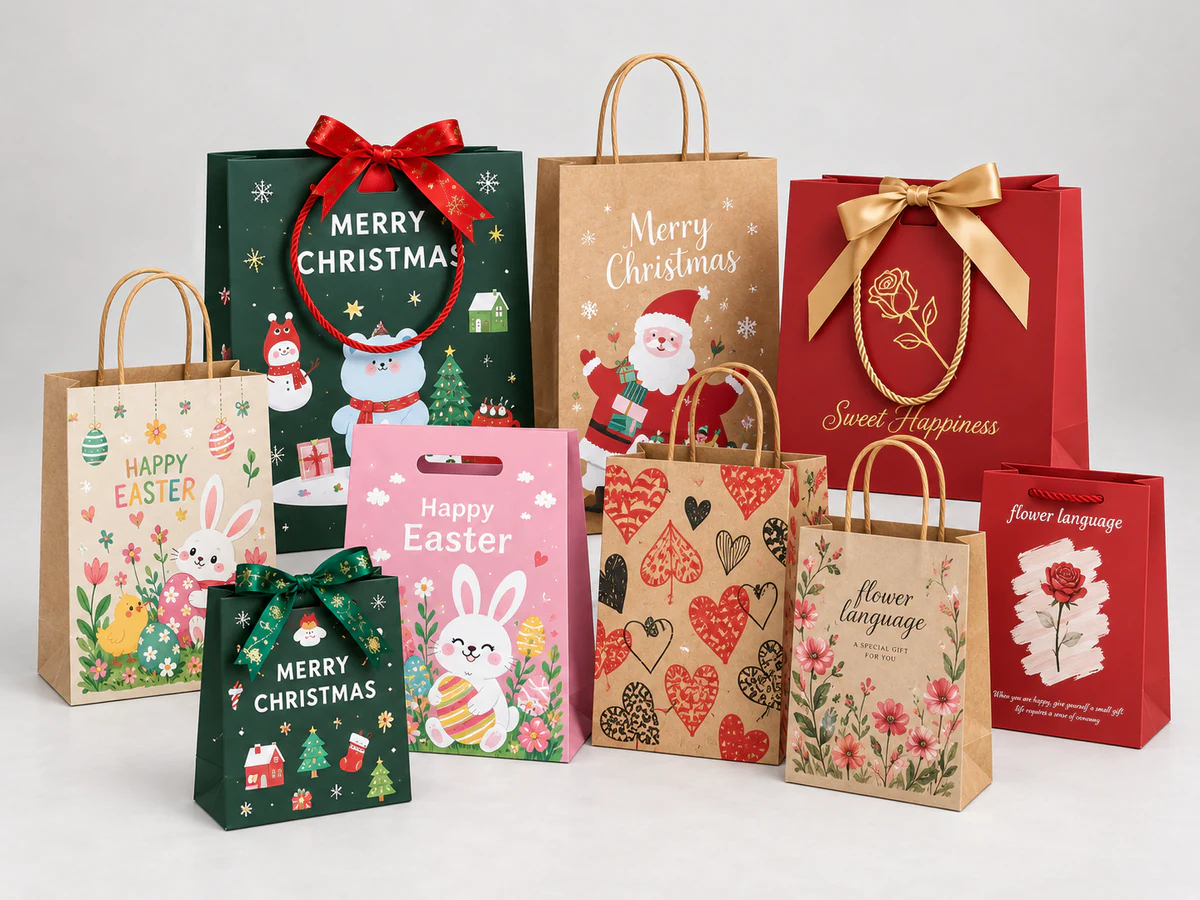
The coordinated bags and boxes in this design example show how the two pieces can form one presentation. Treat the brand photographs here as design references; they do not establish bag-to-box fit or a PAQIVA customer relationship.
For your own range, choose a box with enough room for the folded garment and its wrapping, then choose the carrier around the closed box's outside dimensions. Decide whether the box will travel flat or upright. A bag that works for an unboxed sweater can be too shallow for its gift box; nominal bag dimensions do not guarantee usable internal space.
The additional layer should have a job. If the customer already has a suitable carrier, or the boxed item will be handed over without needing a separate bag, a box-only option may be sufficient. For routine orders with limited margin, keep the everyday bag and reserve the box for gift requests or selected sets.
Keep a mailer box separate from the gift decision
A printed fold-over box can give clothing a tidy unboxing experience. Whether it can serve as the shipping package depends on its actual construction, closure, contents and shipping conditions; an attractive box is not evidence of transit performance.
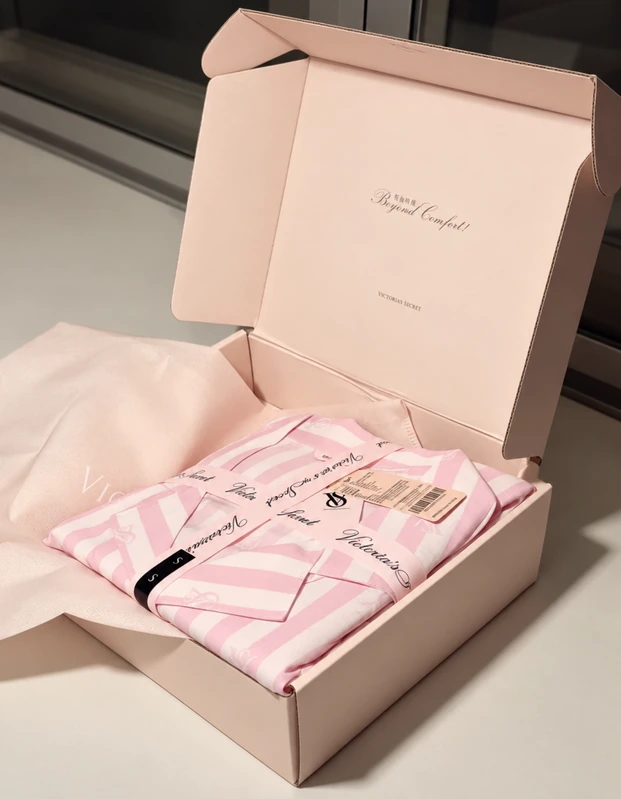
For online orders, first choose the outer packaging that gets the garment to the customer. FedEx's clothing-shipping guidance discusses mailers and corrugated boxes for different clothing shipments. A shopping paper bag is not a substitute for a sealed, suitable shipping package.
Presentation and shipping protection can be separate layers. For example, MR PORTER's published packaging information describes a signature presentation box with a protective outer box. That is one documented service option, not a rule that every clothing order needs two boxes.
If your store hands over a branded mailer-style box, add a bag only when it improves carrying. For a courier order, include a shopping bag only for a defined purpose, such as giving the recipient a carrier for a gift. Include any extra outer carton and parcel volume in the shipping quote: DHL Express explains that its chargeable weight depends on actual or volumetric weight, whichever is higher. A flat-packed box's storage advantage does not mean a small parcel once assembled.
Can a gift box with handles replace both?
A box with integrated handles can combine presentation and carrying in one item. It is worth comparing when customers want a boxed gift they can take away directly. The saving is the separate bag you may avoid; the cost is the complete handled box, including its construction, handle attachments, assembly and delivery.
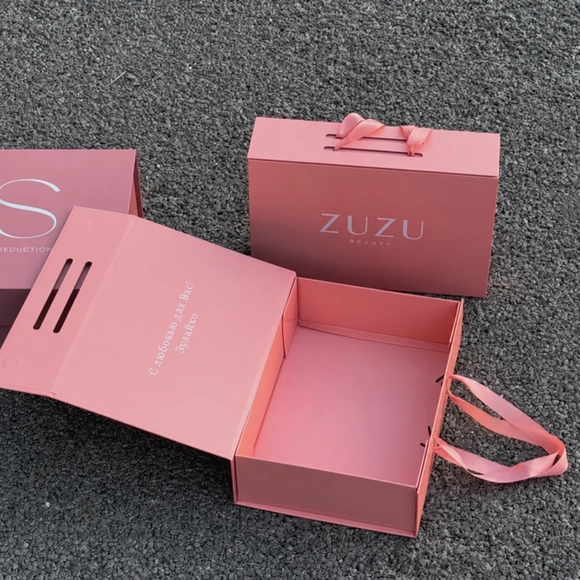
The handled-box example shows the structural idea, not a garment-size recommendation. A similar format must be sized for the folded clothing and checked with the actual load. Handles alone do not prove that the base, attachment points and closure will work together comfortably.
Ask for two complete quotes: a suitable handled gift box, and a suitable gift box plus carrier. Compare equivalent capacity and presentation. A folding structure may reduce empty storage space but add assembly time; a rigid structure may arrive ready to use but occupy more room. Neither format is automatically the lower-cost choice.
Build an everyday option and a gift option
Begin with a simple daily packaging setup and one clearly defined gift upgrade. Use a representative packed garment or gift set to check fit, removal, carrying comfort and closure, and time the actual packing process. That gives the cost comparison inputs your store can use.
For a custom paper-bag quotation, send PAQIVA your folded garment dimensions—or the closed gift box's outside dimensions—together with the intended carrying orientation, load, quantities, artwork and required arrival date. Email sales@paqiva.com; the contact page also lists the details to prepare.
Choose the packaging level your orders can support consistently. A well-planned bag can serve everyday purchases, while a box-and-bag set or a handled gift box can be reserved for the occasions where the extra cost has a clear purpose.