













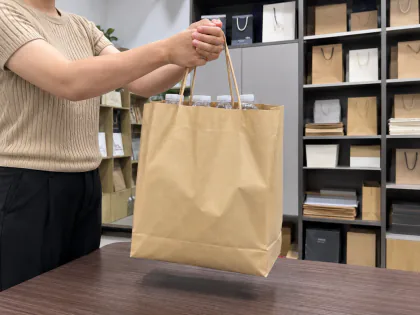
What GSM Should a Paper Shopping Bag Be?
Choose paper weight around your bag size, construction and contents. Compare PAQIVA's 230, 250 and 300 gsm starting points, then check stiffness, folds and actual use with same-size samples.
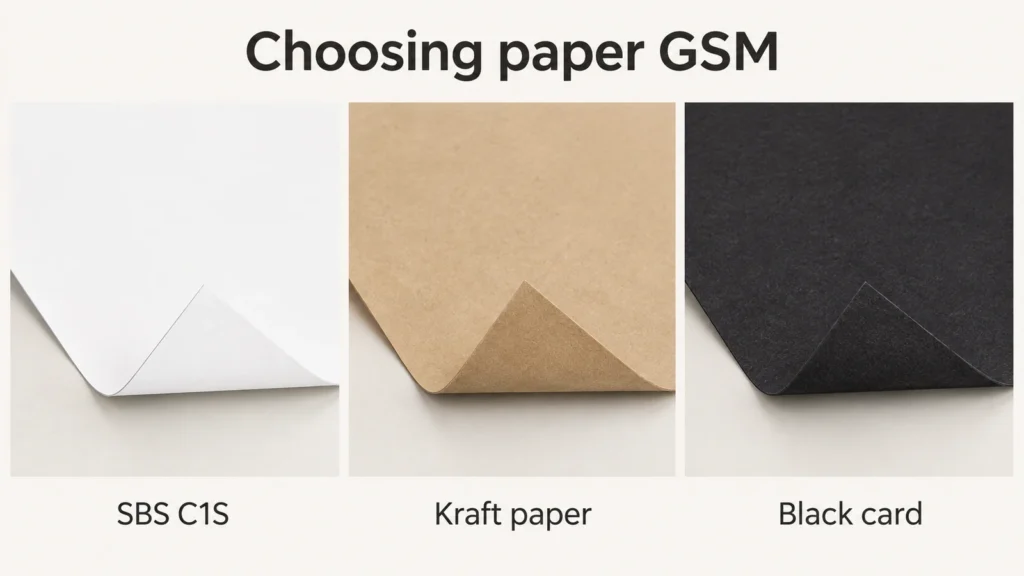
For PAQIVA's white card, kraft and black card shopping bags, 200–300 gsm is a practical starting range. We commonly start at 230 gsm, consider 250 gsm for larger bags, and review 300 gsm for extra-large formats. The aim is a bag that holds its intended shape, folds cleanly and works comfortably with the product inside.
A higher number is not automatically a better choice. In our production experience, going above 300 gsm increases the risk of cracking at folds. Before choosing heavier paper, compare the actual material and bag construction, including the finish you intend to order.
Start with the bag size and the result you want
GSM means grams per square metre: it describes the paper's mass per unit area. It does not tell you the weight of a finished bag or how many kilograms that bag can carry.
Use the following as a starting point for discussing your project:
| Paper weight | How PAQIVA approaches it |
|---|---|
| 200–300 gsm | Our usual range to review for white card, kraft and black card shopping bags. |
| 230 gsm | A common first sample when the size and construction suit the intended use. |
| 250 gsm | An option for larger bags where the panels need more support. |
| 300 gsm | An option to assess for extra-large bags, with particular attention to folding and assembly. |
| Above 300 gsm | Requires closer review because of the fold-cracking risk we encounter in production. |
“Larger” is relative to the project, not a fixed size category. A wide bag for folded clothing and a narrow bag for a compact, heavy box place different demands on the paper and structure. A large bag also does not necessarily carry a heavy product.
For clothing paper bags, start with the folded garment, its wrapping and the room needed to place it inside. Then assess whether the selected paper keeps those proportions looking tidy during use.
The same GSM can feel different in different papers
Two sheets with the same GSM can have different thicknesses. Fibre composition, paper structure, coatings and the way the sheet is compressed during manufacture all affect its feel. Bulk describes how much volume a given mass of paper occupies; greater bulk can produce a thicker sheet without a higher GSM. Holmen's explanation of paper bulk illustrates this relationship.
Thickness and stiffness are also different properties. Thickness is a measurement through the sheet. Stiffness describes its resistance to bending, which also depends on the material and direction of the fibres. Neither value, by itself, establishes the carrying performance of a finished bag.
This is why a 230 gsm white card sample cannot automatically stand in for a 230 gsm kraft or black card bag. PAQIVA's starting range applies to all three, but their appearance, panel support and folding behaviour need separate assessment. Explore the available paper options as materials to compare, rather than treating their GSM numbers as interchangeable specifications.
Compare the same bag in two rounds
Changing the paper, size and handle at once makes it difficult to tell what caused a difference. A useful sample plan separates the choice of paper weight from the choice of paper type.
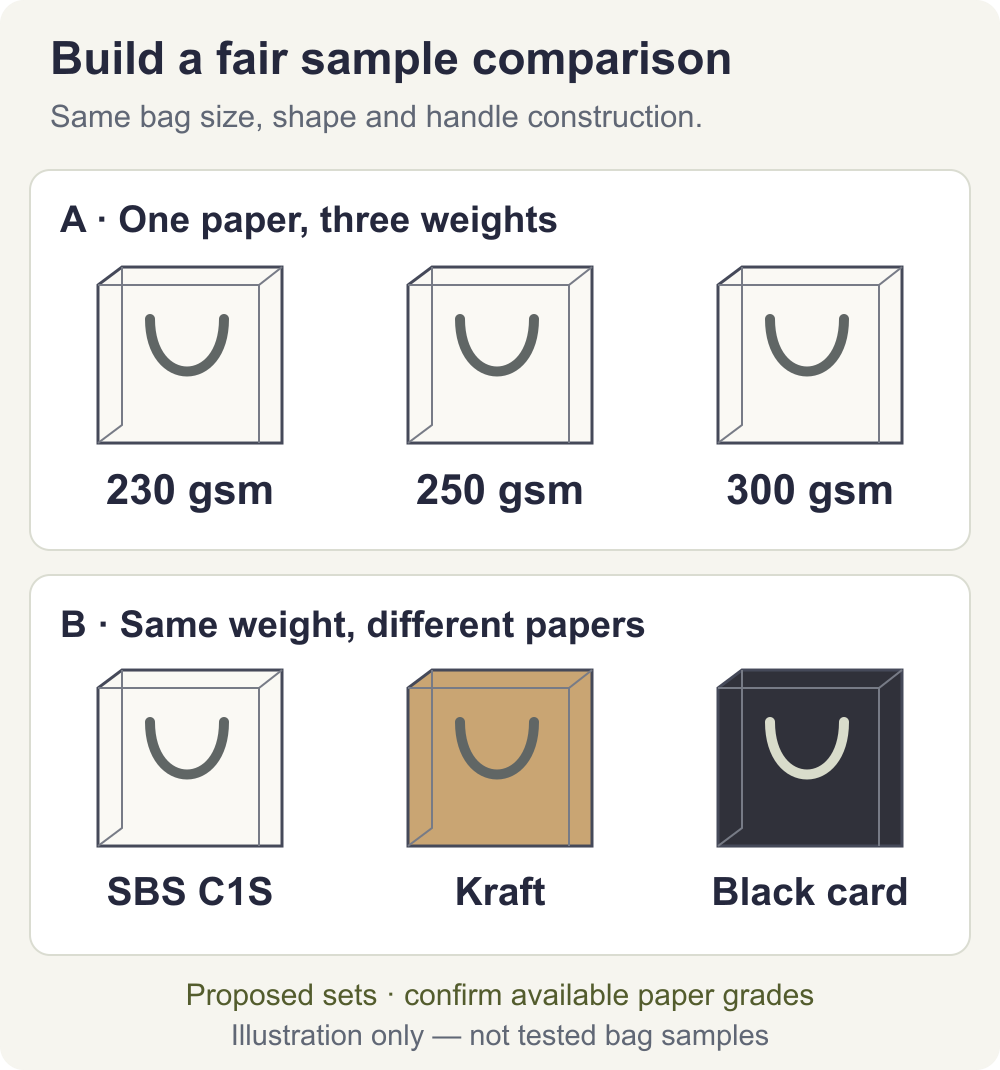
Round one: compare weights within one paper type
Keep one bag size and construction, then compare 230, 250 and 300 gsm within the same paper type and product family, where available. A 230 gsm small bag beside a 300 gsm large bag will not isolate the effect of paper weight.
Keep the handle specification, attachment and agreed reinforcement consistent. Use matching artwork and comparable printing and surface finishes. Record the exact paper grade and any thickness information supplied, so a change of grade does not pass unnoticed as a simple weight increase.
Round two: compare three papers at one available weight
Choose a GSM that can be supplied across white card, kraft and black card, then make the same bag in each. This shows the effect of changing material while holding the paper weight and bag dimensions constant.
Keep the other specifications as close as practical. If a paper requires a different finish, attachment treatment or reinforcement, record it: you are then comparing complete proposed constructions, not paper alone.
Creasing settings must suit each material. Keeping an unsuitable crease setting unchanged would make the comparison less useful. Allow the converter to adjust the crease for the selected paper and thickness. Record the grain direction and any changes to crease settings with the samples.
Why heavier paper needs closer attention at the folds
PAQIVA's caution above 300 gsm comes from the difficulty of forming heavier paper into clean bag folds. More panel stiffness can be useful, but it is only helpful if the top, gussets and bottom also form properly.
The risk depends on more than GSM. Paper moisture, fibre direction relative to the fold, crease preparation, folding pressure and the printed or coated surface can affect the result. Sappi's Fold Endurance technical guidance identifies heavier paper and several of these processing conditions as contributors to fold cracking.
The 300 gsm caution is PAQIVA's working guidance, rather than a universal failure threshold. Some heavier grades can fold successfully with suitable construction and processing; paper below 300 gsm can still crack when those conditions are wrong.
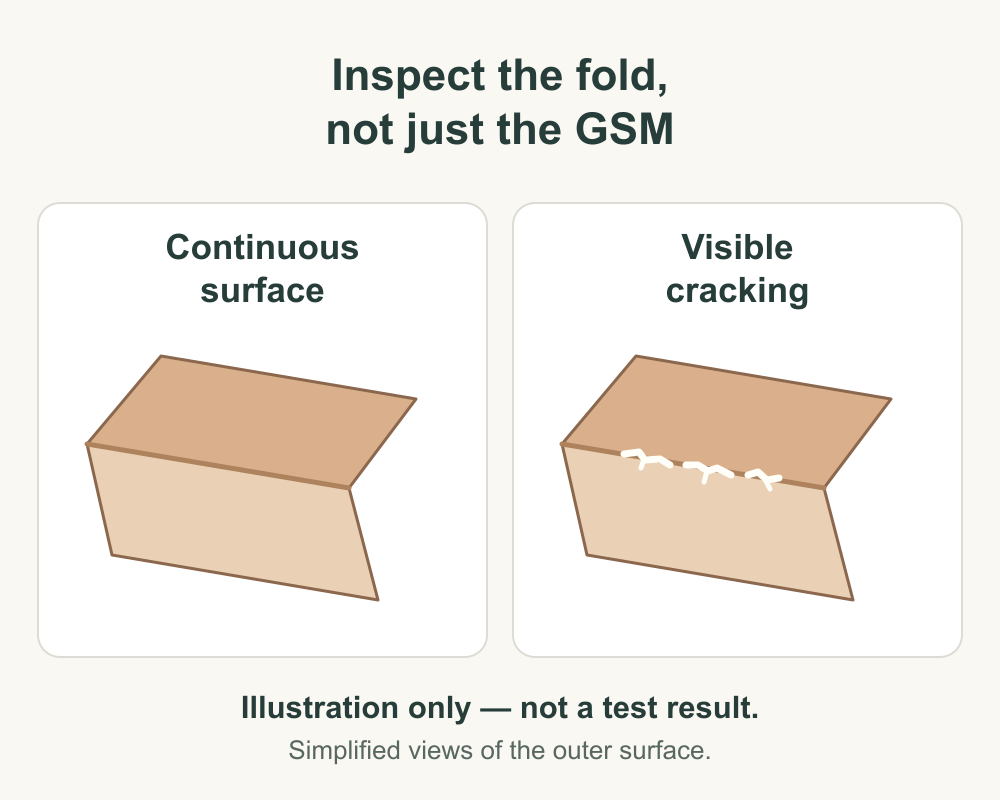
Check the actual fold up close. A pale line, surface flaking and a split through the paper need different attention; a distant photograph may not reveal which has occurred.
Inspect the finished sample in normal use
Compare the samples with the actual product, box, wrapping and any insert. Record the filled weight and use the same handling sequence for each version. Focus on these checks:
- Panel shape: Does the bag stand and hold the presentation you want? Look for excessive bowing, sagging or a stiffness that makes packing awkward.
- Opening and access: Place the complete product inside and take it out. Check that the opening and folded top provide enough room without forcing the corners apart.
- Fold condition: Open the bag fully and inspect the top folds, side gussets and bottom. Check again after handling for cracking, flaking, separation or distortion.
- Handles and joints: Carry and set down the filled bag. Inspect the attachment areas, side seam and base, and note whether anything loosens or changes shape.
- Final appearance: Assess the intended print and surface finish, especially where artwork crosses a fold. A blank sample can demonstrate fit but cannot show how the finished printed surface will behave.
Agree the required carrying procedure and acceptance criteria for the project. A bag that feels stiff when empty has not yet demonstrated that it works with the intended contents.
Specify the paper as well as the GSM
Once a sample works, record its paper type and grade, GSM, dimensions, handles, reinforcement and finish. A substitution with the same GSM may still change the result.
To discuss your paper bag with PAQIVA, send the required dimensions, packed product and filled weight, quantity, artwork and preferred paper appearance. Include any sample you already like. We can use 230 gsm as the initial discussion point, or review 250 or 300 gsm where the size and construction call for it.