














When to Order Christmas Paper Bags: A Retailer’s Backward Planning Guide
Build a Christmas paper bag purchasing calendar from the date your stores need the bags. Allow for approvals, production and freight, count usable stock, and plan a backup.
Start with the date your stores will first use the Christmas bags, then work backward. That might be the start of a November promotion, a gift event or a festive window display. It is usually earlier than Christmas Day.
Allow time for design and sample approval, production, the complete delivery journey and getting stock ready in each store. A shipping estimate alone is not an order deadline.
Start with these production and transport ranges
For an initial PAQIVA planning discussion, use these reference ranges:
| Stage | Initial planning range |
|---|---|
| Production | Usually 7–15 working days, once specifications, sample approval and the production slot are confirmed |
| Sea delivery, DDP | About 30–50 calendar days, including pickup, customs clearance and delivery to the agreed address |
| Air delivery, DDP | About 8–15 calendar days, including pickup, customs clearance and delivery to the agreed address |
The production quantity, bag specification, destination and available schedule determine the actual timing. For early planning, use the longer end of each range, then replace it with the confirmed timing for your order.
In this guide, transport days are treated as calendar days. Production uses working days, following the supplier's operating calendar. Weekends and factory holidays can move the dates, so 15 working days should not be entered as 15 calendar days.
Count the DDP journey once
The sea and air ranges above are DDP delivery estimates covering pickup, customs clearance and delivery. Do not add those stages again when working backward. Confirm the collection date and destination address with your supplier when agreeing on the schedule.
Keep a separate reserve for unexpected delays, followed by time to check and prepare the bags in store. These are planning buffers around the agreed delivery schedule.
A reusable Christmas paper bag calendar
Set your first-use date at the bottom of this calendar, then work upward. Use the same method for another holiday by changing that date and the confirmed lead times.
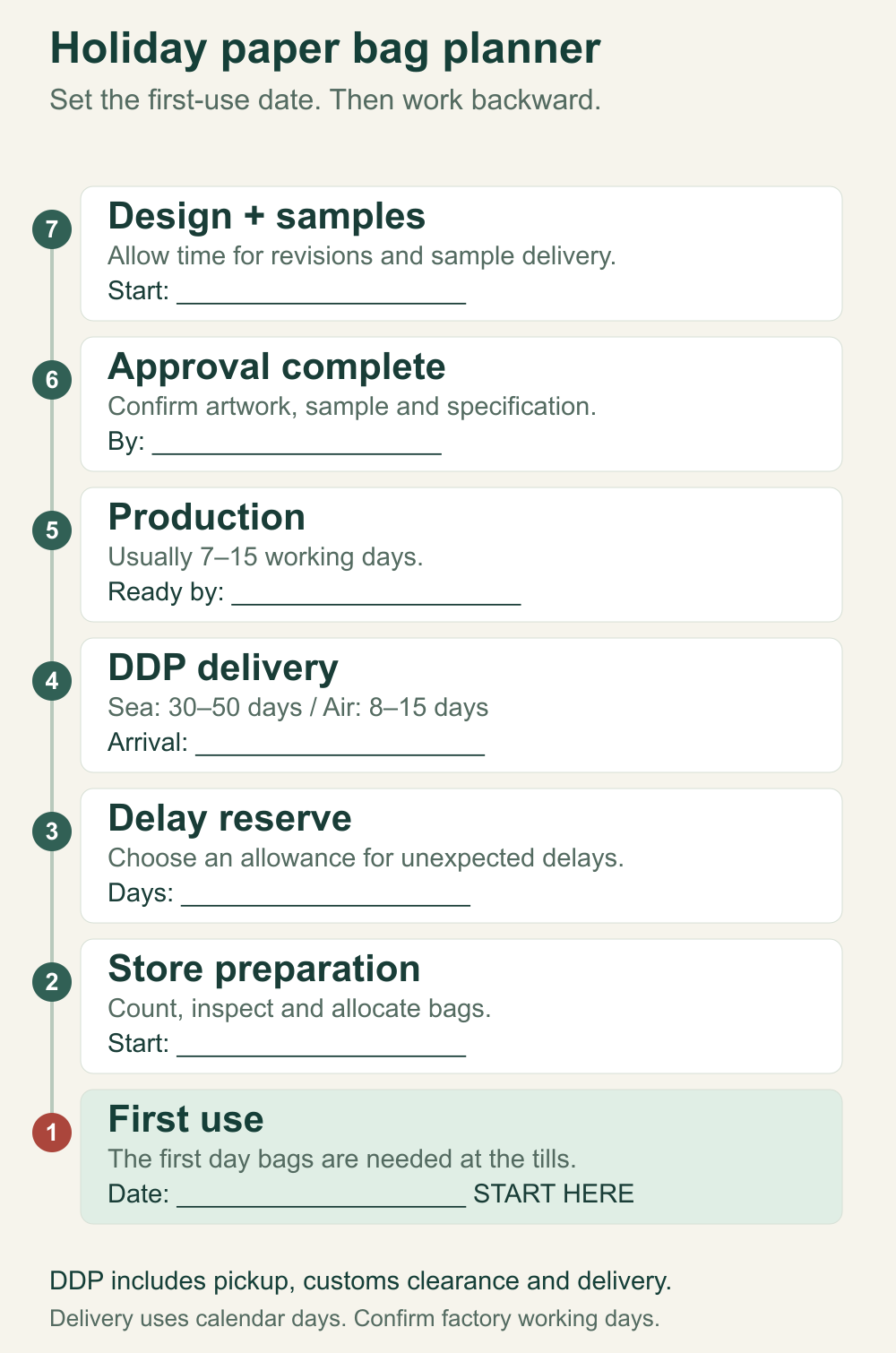
Start with these steps:
- First use: enter the first day bags must be available at the tills.
- Store preparation: allow time to count, inspect and distribute the delivery across stores.
- Planned delivery: move this earlier to leave a reserve for delays.
- DDP delivery: subtract the agreed door-delivery duration once: around 30–50 calendar days by sea or 8–15 by air for initial planning.
- Production: count backward using working days to find the production start date.
- Approval: approve the sample, artwork and specifications before production begins.
- Design and samples: allow time for the brief, artwork revisions, sample making, sample delivery and your team's decision.
A worked planning example could use 7 calendar days for store preparation and 14 for a delay reserve. It could also allow 21 calendar days for design, samples and approval work, plus 15 working days for production and either 50 calendar days for sea DDP or 15 for air DDP.
The 7-, 14- and 21-day allowances are editable examples, not quoted PAQIVA lead times. Confirm the sample schedule and production slot. Move dates earlier for supplier closures and check collection dates against the carrier's schedule.
Using those assumptions and a Monday-to-Friday production calendar with no holidays, a 15 November 2027 first-use date would mean starting design and sample work by 23 July for sea DDP, or 27 August for air DDP. Both plans target arrival on 25 October, leaving the delay reserve before store preparation begins on 8 November.
These are illustrative dates, not a confirmed booking. The example allows 15 production working days including the first and last days, with approval complete by the preceding working day. Production is ready before collection; calculated collection dates still need the carrier's confirmation. Starting the enquiry and placing a fully approved production order are different milestones.
Estimate demand before choosing the order quantity
Count the bags you expect to use during the campaign, by size and store. Last year's usage is a starting point; adjust for this year's trading period, promotions, store numbers and how many purchases need a bag.
Use a simple calculation for each size:
Bags to order = expected use + reserve − usable leftover stock − confirmed incoming stock that will arrive in time.
For example, 1,200 expected bags + 120 reserve − 300 usable leftovers − 100 confirmed incoming bags = 920 bags to order, before confirming order quantities with the supplier. The reserve is an example; choose yours based on demand uncertainty and how quickly you could replenish. If the result is below zero, there is no additional quantity to order for that size.
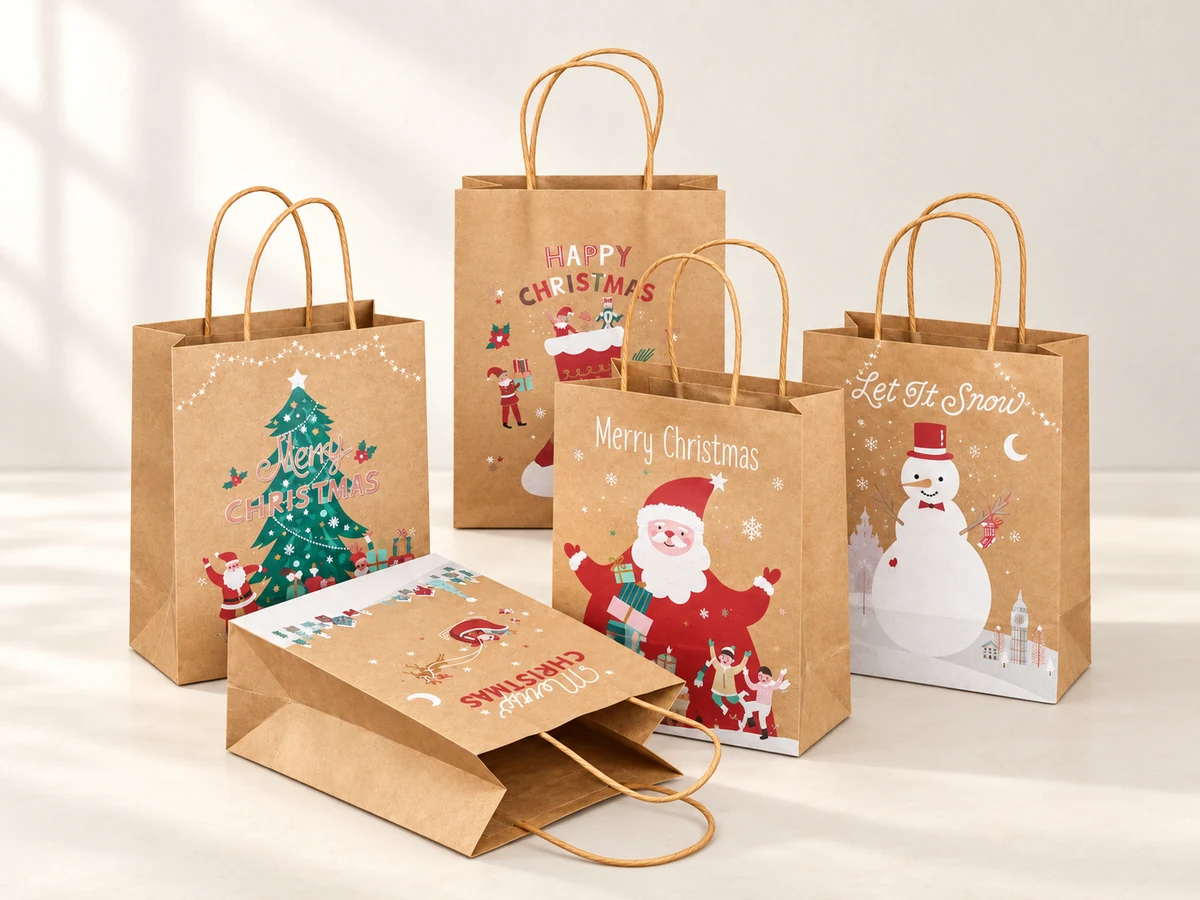
Only count leftovers that are usable and still suitable: check the handles, creases, moisture damage, print and size mix. A Christmas design without a year may remain useful next season, provided the branding still fits. Date-specific campaigns or changed artwork can make apparently cheap extra stock less useful.
Decide on a delay backup before it is needed
Set a review date against your planned production completion and freight handover. If the confirmed schedule no longer supports the store deadline, agree on the alternative while there is still time.
- Split the shipment: price a smaller urgent quantity by air and the balance by sea. Confirm both arrival plans and the extra cost.
- Use available backup bags: a suitable year-round bag with a seasonal tag or ribbon can cover an initial shortfall.
- Simplify an unapproved design: check whether available materials or fewer finishing steps would help. Confirm the revised specification and sample before production.
- Prioritise stores and sizes: reserve the first delivery for the locations and formats with the greatest immediate need.
An air DDP option still depends on production readiness and available capacity. Its estimate already includes clearance and delivery, but the shorter journey alone does not guarantee the store deadline. Recheck the full calendar.
Contact PAQIVA with the first-use date, delivery postcode and country, quantity by size, artwork status, bag specification and preferred transport method. Ask for a schedule covering approval, production completion, freight handover and delivery to the agreed address.