













Nike Kraft Paper Bags: Design Review and Four Measured Sizes
Bold black graphics, brown kraft paper and four distinct sizes: a closer look at Nike sample bags and the lessons they offer for retail packaging.

Nike's kraft paper bags show how a simple material palette can carry a bold retail identity: brown paper, black handles, oversized graphics and fine geometric lines. The four samples in this review also offer a useful sizing lesson. A store's bag range works best when each size serves a different purchase, rather than simply making the same bag larger.
The S, M, L and XL dimensions below were measured by hand from the sample bags. They are approximate, in centimetres: front width × side depth × bag-body height, excluding handles. They are not an official Nike size chart and do not represent every store worldwide.
What makes this kraft bag design stand out?
The first thing you notice is the contrast. The black Swoosh and lettering have enough visual weight to stand out against the brown paper, while the much thinner lines give the surface detail without competing with the main mark.
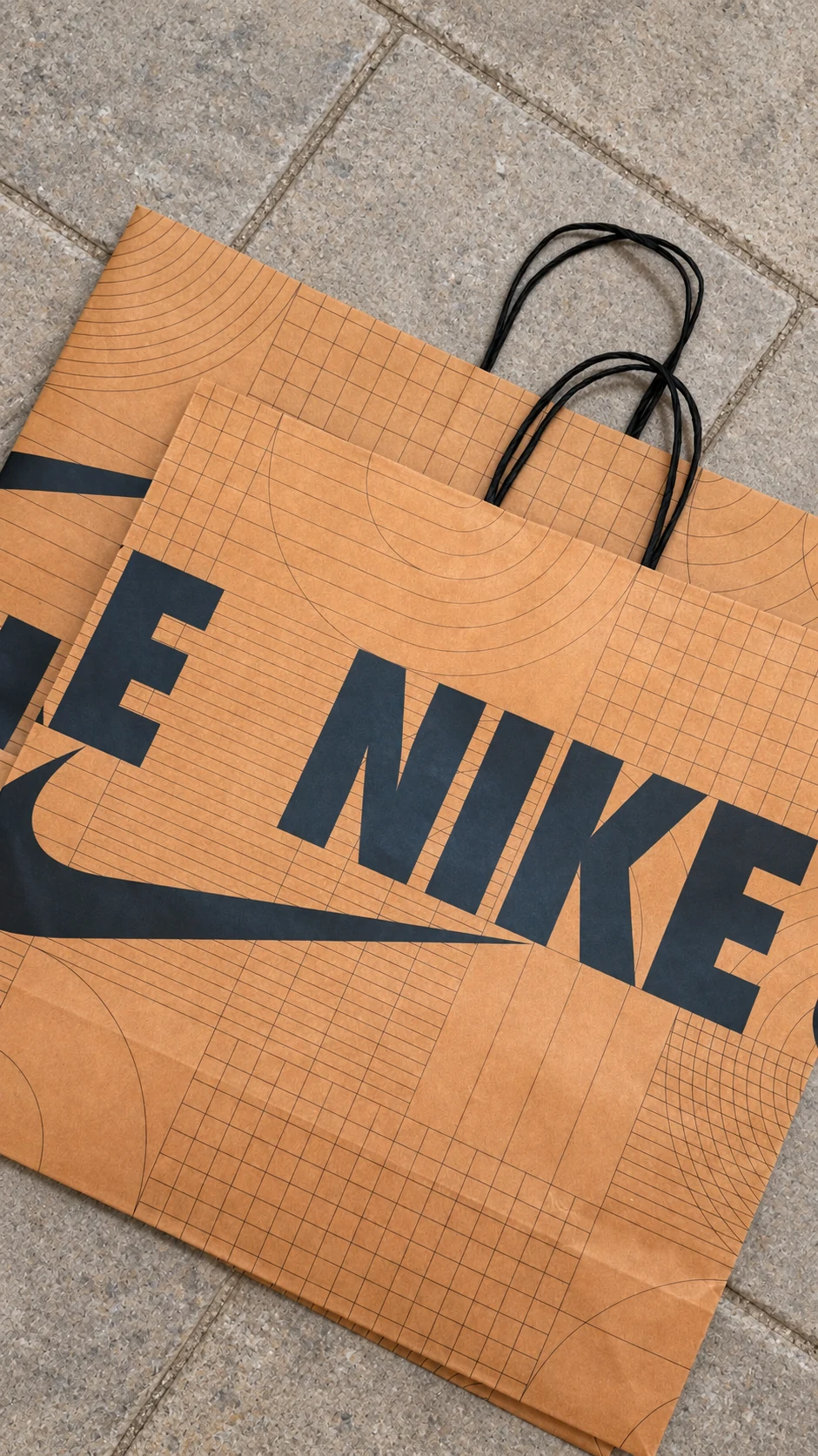
The grids and sweeping curves suggest sports-court markings—a visual reading of these samples, rather than a claim about Nike's design brief. Close up, there is plenty to look at; from a distance, the larger shapes remain the focus.
The artwork also changes position across the bags. The Swoosh sits higher on some fronts and lower on others, and sections of the lettering run towards the edges. The result feels like one family without making every panel identical. For an independent retailer, the useful idea is to keep a consistent colour palette and graphic style while composing the artwork for each bag's proportions.
The kraft surface and dark, slender handles complete that restrained appearance. These photographs let us discuss the look, but do not establish paper weight, recycled content or handle composition.
Four hand-measured sample sizes
| Sample | Dimensions (cm) |
|---|---|
| S | 25.5 × 12 × 30.5 |
| M | 41 × 15.5 × 33 |
| L | 49 × 16 × 38 |
| XL | 53 × 18 × 51 |
The white shoebox shown in the following photographs is a visual reference. The source photos identify it as a women's size 38 shoe box; shoe size does not specify the box's external dimensions. The suggested uses below are starting points for a retailer's own packing trials, not verified capacity ratings for these bags.
S: a compact, upright format
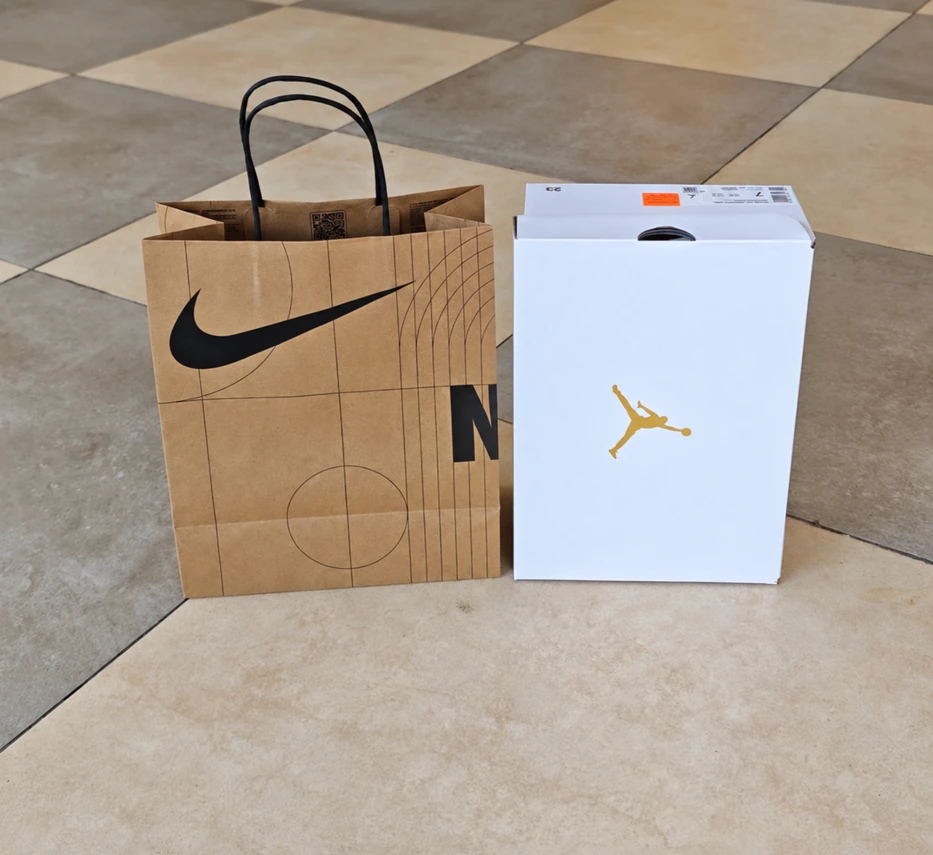
At 25.5 × 12 × 30.5 cm, S is the narrowest sample. Its upright shape offers a useful reference for small purchases: accessories, a lightweight folded top or a compact children's shoebox, if its actual dimensions allow.
The practical benefit is presentation. A small purchase need not disappear inside a bag intended for a much larger box. The white reference box beside this sample also makes the limited front width easy to see.
M: the big change is width
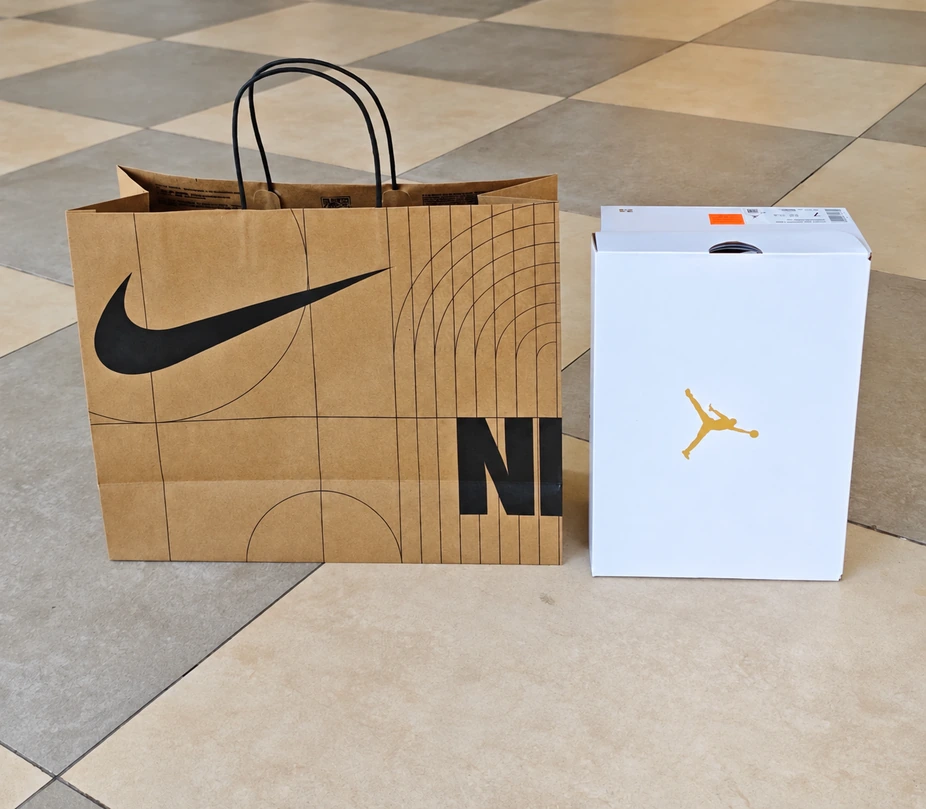
M measures 41 × 15.5 × 33 cm. Compared with S, it gains 15.5 cm in width, but only 2.5 cm in height. This is a different packing shape, with a broader opening for wider packages and folded clothing.
For a footwear-and-apparel shop, a format like this is worth trying with the most frequently sold shoebox and ordinary clothing purchases. Whether it becomes the main bag should follow those everyday purchases, not the letter M alone.
L: more room across the front, almost the same depth

At 49 × 16 × 38 cm, L adds 8 cm of width and 5 cm of height over M. The easily missed detail is the side depth: it increases by only 0.5 cm.
That matters when planning bags for several items. A wider front can help with a broader arrangement, yet a thick box may still run into the same depth restriction. Try this role with a shoe purchase plus clothing, or a larger folded clothing bundle, and check the complete package arrangement.
XL: a substantial increase in height
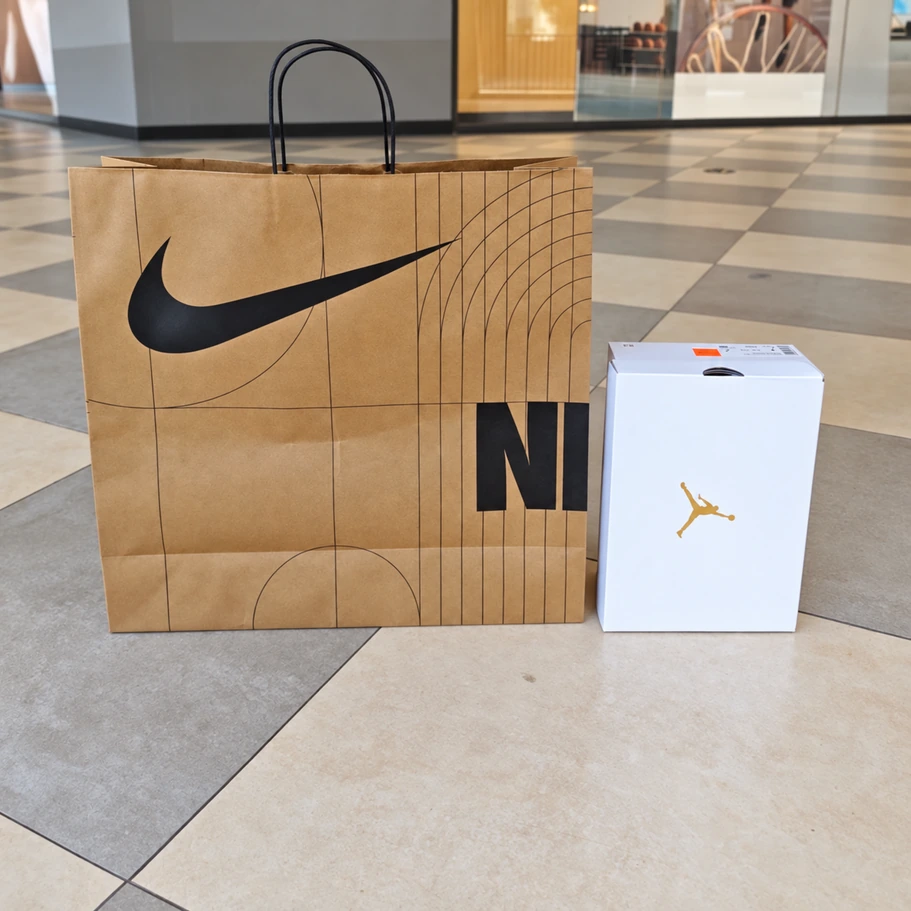
XL measures 53 × 18 × 51 cm. Relative to L, the width rises by 4 cm and the depth by 2 cm, while the height rises by 13 cm. Its most distinctive feature is the taller body.
This makes it an interesting reference for bulky outerwear or taller combinations of purchases. It does not mean the bag will hold a fixed number of shoe pairs: different boxes occupy different amounts of space, and available space alone does not establish carrying strength.
What should a store borrow from this size range?
Give every size a clear job. For a shop selling footwear and clothing, four useful roles are a small-purchase bag, an everyday bag, a mixed-purchase bag and an occasional bulky-purchase bag. These samples make those roles easy to visualise; their exact dimensions need not become your own specification.
Start with the items actually leaving your checkout. Set out a small purchase, your usual shoebox or folded garment, a common multi-item purchase and the largest combination you regularly sell. Pack them as customers receive them, including boxes and wrapping. Bag measurements describe the exterior; folds and construction reduce the space available inside.
For stock quantities, put the largest share into the format that fits ordinary purchases. Keep the largest bag as a smaller supporting stock unless bulky orders are routine. A fourth size earns its place when it regularly prevents awkward packing; otherwise, three well-chosen sizes may be enough. Our clothing-store paper bag size guide covers starting quantity mixes and replenishment in more detail.
The design lesson is just as useful: repeat a recognisable visual language, then adapt its layout to each size. Use your own brand identity and the shapes your products require. That gives a retailer a coordinated range with a practical reason for every bag.
This article is an independent design and sizing review. The Nike-branded bags shown are reference samples, not products offered for sale by PAQIVA.