













Digital vs Offset Printing for Custom Paper Bags: How to Choose
Digital suits many samples and very small runs; offset often becomes attractive as quantities grow. Compare the complete bag and agree what a sample proves before production.

For samples and very small runs, digital printing is often the practical first option. For a repeated design at 500 paper bags or more, PAQIVA usually considers offset first. The decision depends on the quantity of each design, the paper, the print coverage and the finished bag you need.
In our usual projects, samples are often digitally printed. We may also consider digital for fewer than 100 bags or for suitable stock-size bags with simple added printing. Around 300–500 bags, spreading offset setup costs across the order can make its price more attractive. These are starting points from our order experience, rather than universal minimums or a promise that every specification is available at those quantities.
Start with quantity per design
Count bags by size and artwork version before comparing prices. An order for 500 identical bags is different from 500 bags split across five designs. Several versions may require additional setup, even when the total quantity looks suitable for offset.
| Order situation | Route to consider first | What could change the choice |
|---|---|---|
| Physical sample or fewer than 100 bags | Digital | Paper compatibility, finish and available bag size |
| Short run using a stock-size bag | Digital overprinting, where suitable | Printable area, bag construction and artwork coverage |
| Around 300–500 bags of one design | Compare both routes | Setup cost, sheet layout, paper and finishing |
| 500 or more bags of a repeated design | Usually offset in our projects | Multiple versions, special stock or the required schedule |
Quantities between these examples need a project quote; there is no automatic switch at one exact number. Ask for the same bag specification in both quotations so that a cheaper paper, smaller print area or omitted finish does not disguise the real difference.
Why setup costs change the answer
Digital printing transfers a digital file to a compatible printing system without producing a separate conventional offset plate set for that job. This makes it useful for samples, short runs and changing artwork. Xerox explains these advantages in its overview of digital printing. File preparation, machine settings and test output still take work; digital does not mean zero setup cost.
Offset has plate preparation and press setup, including getting the ink and printed result ready for the run. Once that work is spread over more identical bags, its cost per bag becomes easier to justify. Our preference for offset on many orders of 500 bags or more comes from this practical balance.
Compare the complete order: printing, paper, finishing, bag assembly, packing and any separate sample charges. A useful way to read the quote is setup cost divided by quantity, plus the variable cost per finished bag. The cheapest printing line alone may not produce the cheapest finished order.
Match the design to the production route
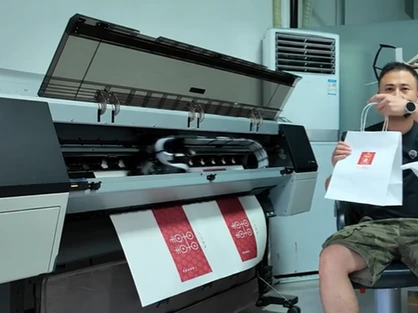
A small logo on an existing bag and artwork covering the entire unfolded bag are different jobs. Simple printing on suitable stock bags can avoid making a new bag size, but the machine must accommodate the bag's shape, folds and handles. The available print area may be restricted. A logo that works on a flat front panel does not establish that full coverage across gussets or folds is possible.
For custom bags printed as sheets before assembly, the layout can be planned around the front, back, side panels and folds. Our printing and artwork guide explains how artwork relates to the confirmed bag layout.

Digital is also worth discussing when each version has a different message or graphic. Whether variable printing is possible depends on the equipment and job; do not assume the stock-bag machine shown can print every design or position. Offset is often a good fit when the same artwork will run consistently across a larger batch.
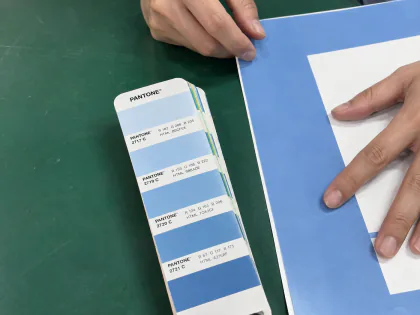
This choice is separate from CMYK versus Pantone for paper bags. Digital and offset describe production methods; a color specification describes the result being requested. Giving a color reference does not, by itself, choose the press or guarantee the match.
Paper and finish matter as much as the method
In our usual custom-bag work, we often prefer offset for the color reproduction and surface appearance of the selected design and paper. That is a project judgement, not a rule that digital printing is poor quality. A strong digital result on one stock can look better than an unsuitable or poorly controlled offset result on another.
White coated paper, brown kraft and textured stocks change how printed artwork appears. Ask whether the proposed paper is supported by the chosen machine, including its thickness, surface and any required preparation. A paper being available for the bag does not automatically mean it is suitable for every printing route.
Look especially at large solid areas, fine text, gradients and the relationship between printed and unprinted surfaces. Ink or toner systems can leave different surface appearances. Lamination or coating can then change the gloss and perceived color again. Compare the intended finished surface when that effect matters to the purchase.
Separate print speed from the delivery date
Digital can shorten preparation for a small job because it avoids making a conventional offset plate set. It does not remove the time needed for paper sourcing, finishing, cutting, folding, handle attachment or shipping.
An urgent larger order is therefore not automatically a digital order. Available press capacity and the rest of the production schedule may matter more. Request a schedule that identifies artwork approval, sample approval, production, finishing and dispatch, rather than comparing only how quickly a machine can print.
When the sample is digital and production is offset
This is common in our sampling approach. A physical digital sample can help you review the artwork position and assembled bag before committing to offset production. Its usefulness depends on what was reproduced accurately: if the paper or finish differs, the sample is also limited as a guide to stiffness, surface feel and folded appearance.
Before approval, agree what the sample is approving and what requires a separate production reference:
- Bag construction and artwork. Identify the approved dimensions, artwork version, logo position, folds and handles. Note any substitute components or materials in the sample.
- Paper and finish. Record the intended production paper and surface treatment. A digital sample on a substitute white stock cannot establish the final appearance on brown kraft or after lamination.
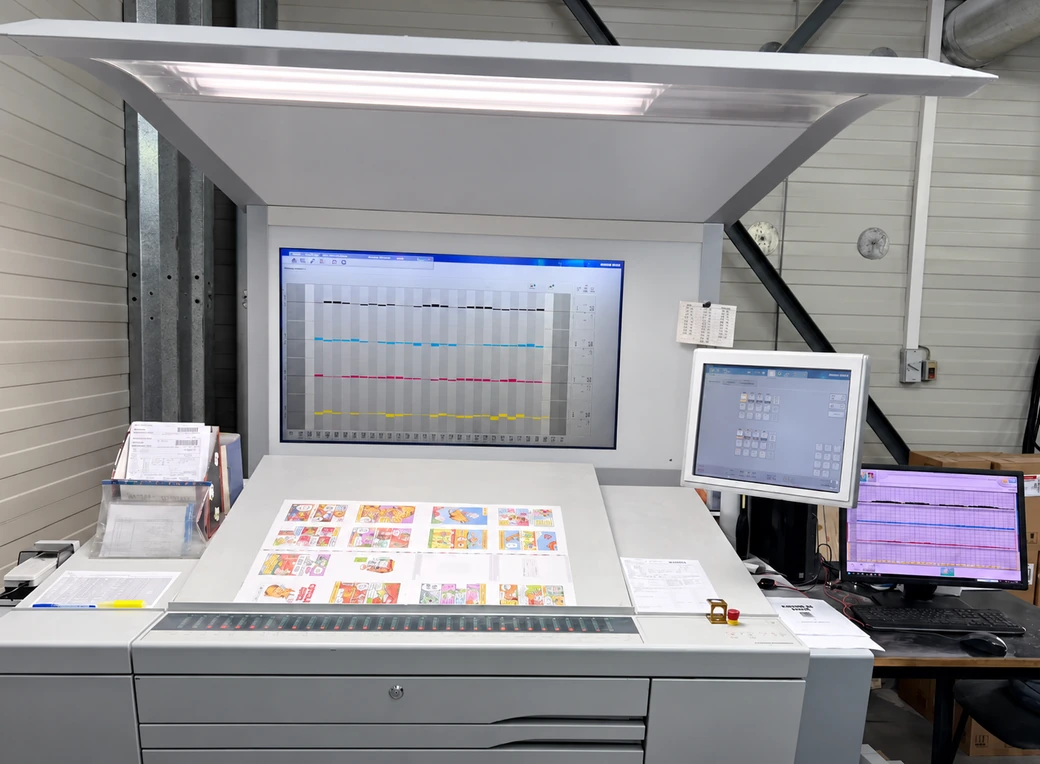
- Color and printed surface. Agree the color reference and how it will be evaluated. If color or a large solid area is critical, discuss an offset press sheet or another proof made through the planned production route, on the intended stock. A calibrated digital contract proof can also serve as a color reference when it simulates the agreed production condition; ISO 12647-7 addresses this kind of digital proofing. Agree the proof's scope, cost and timing before scheduling it.
- Approval before the remaining work. Where a press sheet is approved separately, decide when that happens and how any later finishing will be assessed. Keep the approved reference and artwork version available for production comparison.
A photo sent by email can help communicate a layout issue, but it is a weak basis for judging an exact printed color or surface finish. If the digital sample is approved for construction and layout only, write that clearly in the approval record. Do not let a general “sample approved” message imply that every visible feature will be identical after a change of printing method.
What to send for a useful comparison
Send PAQIVA the bag dimensions, quantity for each size and artwork version, artwork files, preferred paper and finish, and the date the bags are needed. Mention whether a stock size is acceptable and whether the sample must represent production color as well as construction.
Email sales@paqiva.com with these details. We can assess whether digital sampling, stock-bag overprinting or offset production is suitable, and make the sample-to-production differences part of the quotation and approval discussion.